
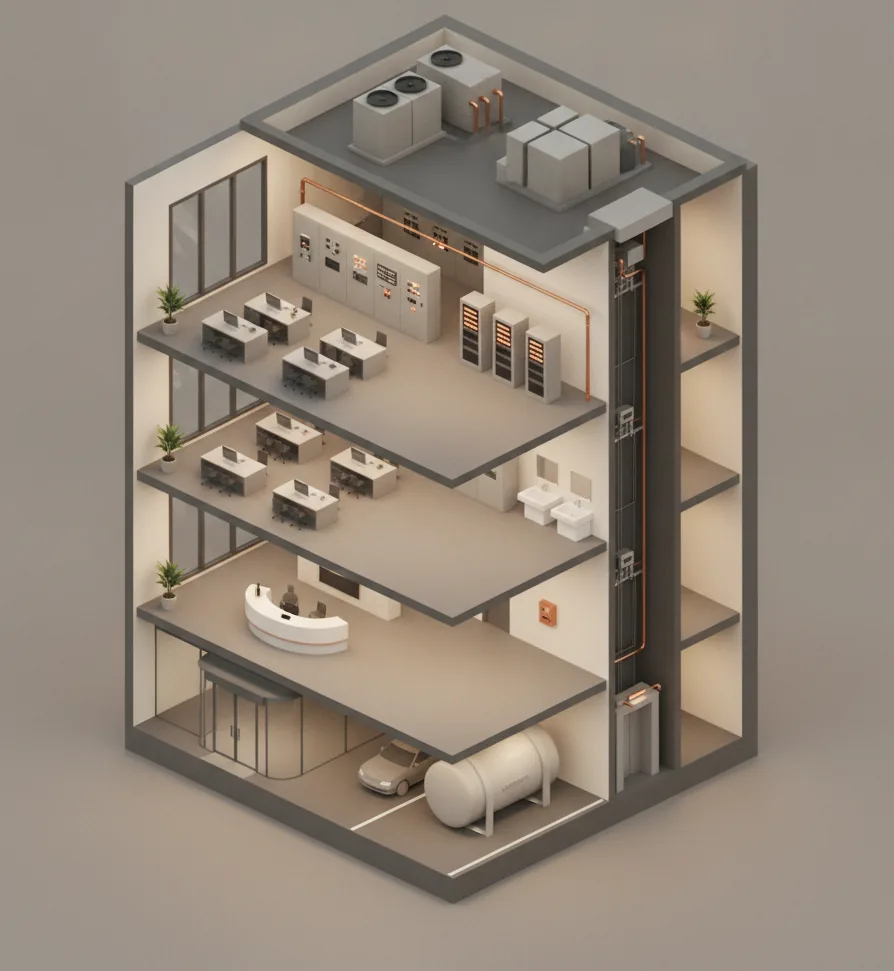
what we protect · what we prevent.
- +Verifiable per-building IAQ · documented post-COVID compliance · parents and staff satisfied
- +NOM-251 school cafeteria · alert before serving out of temperature · COFEPRIS backed with data
- +Nighttime access watched · equipment theft in labs and sheds avoided
- +Per-faculty sub-metering · granular budget billing · recurring CFE savings
- +Generator always ready for critical zones · reagents and samples protected
- ✕Sanitary outbreak in classroom without documented IAQ · institutional responsibility
- ✕Mass cafeteria food poisoning · COFEPRIS shutdown · damaged institutional image
- ✕Lab equipment theft or vandalism · expensive replacement + repair
- ✕Permanent CFE GDMTH surcharge · educational budget eroded
- ✕Blackout destroys lab reagents · years of research lost
eight use cases · four critical areas.
for the institution director.
School Director or Vice-Rector + General Services Lead. Two cases · elevated CO₂ in peak-hour cafeteria or auditorium, insufficient ventilation in labs with reagents. Post-COVID compliance + STPS for teaching staff.
for the cafeteria lead.
Cafeteria Lead + School Services Director. Two cases · cafeteria walk-in cooler fails on weekend, hot display <60 °C at lunchtime. NOM-251 + COFEPRIS log that fills itself.
for the institutional security lead.
Institutional Security + Watch. Two cases · access to lab or equipment shed after hours, uncovered nighttime campus perimeter. Theft and vandalism prevented.
for the institutional CFO.
Institutional CFO + Academic Director. Two cases · per-faculty CFE GDMTH spending without visibility, blackout destroys lab freezer reagents. Sub-metering + continuity for critical zones.
three compliances · one platform covers all three.
For multi-site educational systems (universities with regional campuses, state SEP systems), cross-campus dashboard with executive view for rector or secretary of education.
from sensor to report · every few minutes · without human intervention
Five steps. They run in parallel across all your sites, all the time. When something crosses a threshold, the flow completes in under five minutes — alert delivered, response logged, inspector-ready evidence captured.
measure
Sensors measure temperature, humidity, current, door-open, leak and other magnitudes every few minutes — no operator required.
detect
The system compares each reading against the threshold configured per recipe · per site · per equipment. Threshold crossing triggers the flow.
alert
The alert routes to the right person via WhatsApp, email or push · per role and schedule configured.
respond
The operator acts from the dashboard or mobile app. The corrective action goes into a timestamped log with signature, which can’t be edited.
audit
Everything becomes part of the audit package · time series, critical events, corrective actions, NOM report ready in two clicks.
Five steps · no manual operators · no paperwork · no gaps.
five phases · per school or campus.
site survey + institutional review
2-3 daysTechnical visit + inventory of buildings, cafeterias, labs, access · critical-zone identification · per-academic-stage deployment plan.
physical installation
2–7 days per sitePer-building IAQ sensors + cafeteria cold chain + critical access + per-faculty sub-metering + gateway that stores readings while offline and uploads them when the connection returns · vacation-period or weekend work.
configuration + integration
2 daysIAQ + NOM-251 + STPS thresholds · per-academic-agency sub-metering · report templates for parents + audit + COFEPRIS · WhatsApp alerts per role.
team training
1 dayDirector + Services Lead + Cafeteria + Security + Institutional CFO · each role trains on their alert and report flow.
30 days of support + first academic cycle
30 daysAstreaIoT specialist available · first monthly report delivered to parents and direction · first cafeteria COFEPRIS audit backed with data.
For multi-campus systems (UNAM, IPN, state universities), per-site deployment with semester waves · first-campus time-to-first-report in 30-45 days.
common questions · before the quote.
is it billed as institutional CapEx or operational service?
Both models · CapEx (institution buys hardware + SaaS subscription) or multi-year operational service. Procurement via LAASSP or specific education-system bidding. Per-academic-cycle contracts also supported.
can it be deployed per full classroom in K-12?
Yes but cost-intensive · 1 sensor per classroom × 1000 classrooms = significant investment. Recommendation: start with aggregated per-building sensor + cafeteria + labs + critical areas; scale to per-classroom in priority zones per budget.
does it integrate with school admin systems (el sistema administrativo escolar)?
Yes · via Custom Integration. Operations and compliance data arrive at the institutional administrative system. It connects to your administrative system; sized in the assessment.
is student and staff privacy respected?
Zero cameras. Only ambient sensors aggregated per building + binary sensors (motion, door). Complies with LFPDPPP. Parents receive per-building IAQ reports, not per individual student.
what about the post-COVID parents report?
Pre-configured templates · monthly downloadable report with per-building IAQ + cafeteria conditions + auditable access. Accessible language for non-technical parents.
does it work in rural schools without own internet?
Yes · gateway with cellular backhaul or solar. Compatible with rural schools without own Wi-Fi. LoRaWAN coverage reaches where Wi-Fi does not.
is cafeteria fire detection part of the system?
No. The detectors belong to your fire-prevention program (NOM-002-STPS-2010). We watch the cold chain, the hot display and kitchen temperature, with immediate alert to the principal.