
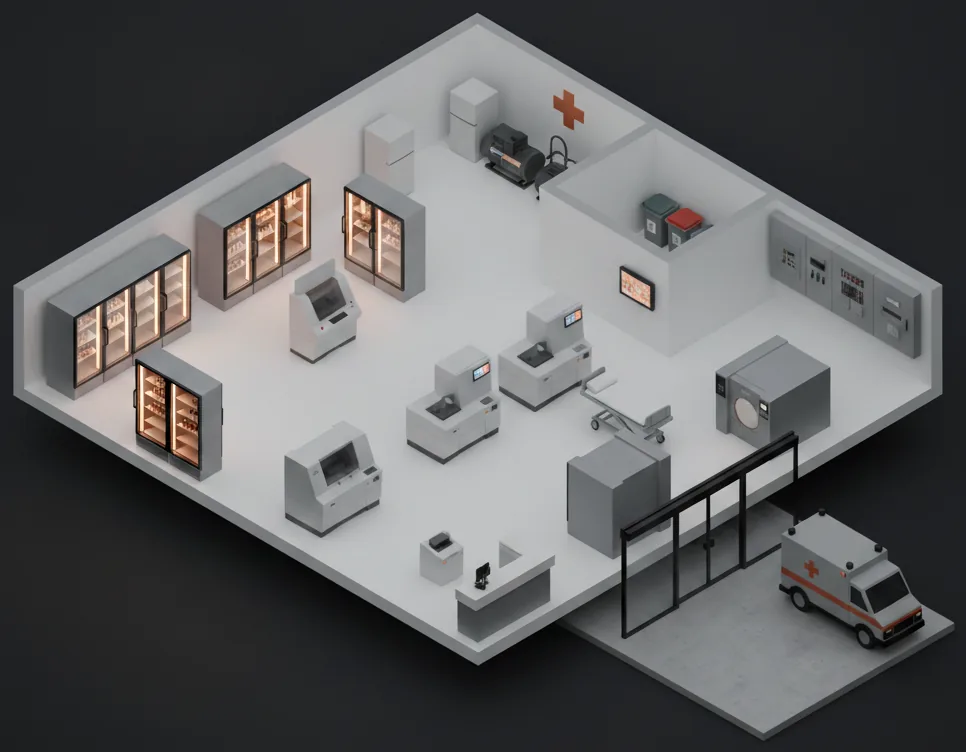
what we protect · what we avoid.
- +More than three hundred thousand pesos saved per blood-bank refrigerator failure · the sensor costs a fraction of the product it protects
- +Automatic NOM-253 / FEUM PDF report in two to three minutes for COFEPRIS, JCI or Consejo de Salubridad General audit
- +Surgery on time at 6 AM (operating-room humidity in spec) protects surgical income and avoids rescheduling fasted patients
- +Energy restored in minutes vs half an hour · generator verified by continuous monitoring during CFE outages
- +Standardization across twenty-five to twenty-eight hospitals in a chain with multi-campus dashboard and internal benchmarking
- ✕Multimillion-peso medical-legal liability from a compromised body in custody or patients on mechanical ventilation during a generator-less outage
- ✕Hundreds of thousands of pesos in biologics, insulins, chemotherapy lost to a refrigerator door left ajar after inventory
- ✕Hospital license suspended due to sustained logbook gaps
- ✕Nosocomial infections from undetected poor ICU ventilation
- ✕Period-result invalidation in the blood bank from NOM-253 record gaps
twelve use cases · four critical areas.
for the responsable sanitario.
Responsable Sanitario + Blood Bank Lead + Hospital Pharmacy Director. Five cases · blood bank, ultra-cold samples, hospital pharmacy, hospital vaccine storage, and morgue freezer — each critical equipment has specific coverage.
for the medical director.
Medical Director + OR Lead + ICU/NICU Lead + Quality Director. Three cases · operating room with out-of-range humidity before surgery, ICU/NICU with high CO₂ affecting critical patients, medical-gas leak in cylinder storage · lives and compliance simultaneously.
for the maintenance lead.
Maintenance Lead + Infrastructure Director. Two cases · backup generator that fails to start during a blackout puts the entire hospital at risk; plant-room leak threatens chillers and critical boilers · continuous monitoring eliminates both surprises.
for the general director.
General Director + Quality Director + Group Operations Director. Two cases · triple audit (COFEPRIS + Consejo de Salubridad General + JCI) and chain rollouts with 25-28 hospitals require auditable reports in minutes and multi-campus dashboards to identify systemic patterns.
three regulations · one platform covers all three.
For hospitals with JCI certification or international equivalent, we add the additional KPIs (cross-campus standardization, internal benchmarking, ESG/quality report) to the dashboard at no extra charge.
from sensor to report · every five minutes · without human intervention
Five steps. They run in parallel across all your sites, all the time. When something crosses a threshold, the flow completes in under five minutes — alert delivered, response logged, inspector-ready evidence captured.
measure
Sensors measure temperature, humidity, current, door-open, leak and other magnitudes every five minutes — no operator required.
detect
The system compares each reading against the threshold configured per recipe · per site · per equipment. Threshold crossing triggers the flow.
alert
The alert routes to the right person via WhatsApp, email or push · per role and schedule configured.
respond
The operator acts from the dashboard or mobile app. The corrective action goes into an immutable log with timestamp + signature.
audit
Everything becomes part of the audit package · time series, critical events, corrective actions, NOM report ready in two clicks.
Five steps · no manual operators · no paperwork · no gaps.
five phases · per hospital.
hospital site survey
2-3 daysTechnical visit · critical-equipment inventory (blood bank, ORs, pharmacy, ultra-cold, generator, medical gases) · NOM-253 + NOM-016 points identification · per-department checklist.
physical install
5-8 daysSensors mounted on blood bank + ORs + pharmacy + ultra-cold + generator + plant room · 32-hour backup gateway · coordination with hospital biomedical engineering.
configuration + calibration
2-3 daysNOM-253 + NOM-016 + FEUM thresholds · probes calibrated at accredited lab · JCI report template ready · role-based escalation.
team training
2 daysBlood Bank Chief + Responsable Sanitario + Biomedical Engineering + Quality Director + Medical Director · each role trains on their flow.
30-day support + first audit
30 daysAstreaIoT specialist on standby · first NOM-253 + NOM-016 monthly report delivered · escalation chain tuned to real hospital operation.
For 25-28 hospital chain rollouts: after the first hospital, phases compact to 2-3 weeks per hospital with monthly waves coordinated with medical direction.
seven questions · honest answers.
what if JCI or COFEPRIS asks for data from several years back?
Immutable log with NTP timestamps · minimum 5-year retention by regulation · longer in contract if you need. The report assembles for the period you select · not truncated data.
does it connect to old or already-certified medical equipment?
The sensors are external · they mount on the refrigerator, operating room or panel without modifying medical equipment. Doesn't affect manufacturer certifications or warranties.
who has access to sensitive blood-bank or pharmacy data?
Role-based access: Blood Bank Chief sees only blood bank, Responsable Sanitario sees pharmacy, Medical Director sees the whole hospital. Every action logged · MFA available for admin roles. records kept under LFPDPPP.
how long does a NOM-253 blood-bank report take to assemble?
Two to three clicks. The system assembles it automatically with the selected period, Responsable Sanitario signature included, format ready for Consejo de Salubridad or COFEPRIS.
what happens to cold chain during a nighttime CFE outage?
32-hour backup gateway + continuous generator monitoring (does it start, fuel level, current quality). If something fails, immediate alert to Biomedical Engineering.
how are sensors calibrated in blood bank or ultra-cold?
Accredited lab before deployment. Per-equipment vigency tracked in the dashboard. We remind you to recalibrate each probe per its certificate (12–24 months depending on use) and keep the certificate next to the log.
does it integrate with the HIS, ERP or the OR system?
Yes · via Custom Integration. Cold-chain data, critical alerts or monthly reports can flow directly to your HIS or central system · without your team exporting CSVs.